As the end of summer nears and Fall approaches, many researchers begin to look forward to the annual Society for Neuroscience meeting, held this year in Washington, D.C., in mid-November. The meeting frequently attracts nearly 20 thousand delegates and as such the program is incredibly diverse, often with Nobel laureates in attendance giving talks and countless talented students presenting poster snapshots of their current research. While the olfactory system and the study of olfaction represent a small part of the program, we are quite proud to play a part in the advancement of science in this field. This publication review highlights some of the recent advances and discoveries related to olfaction and perception, highlighting the most up-to-date understanding of how various species use olfactory information around them to navigate the dangers of their environments.
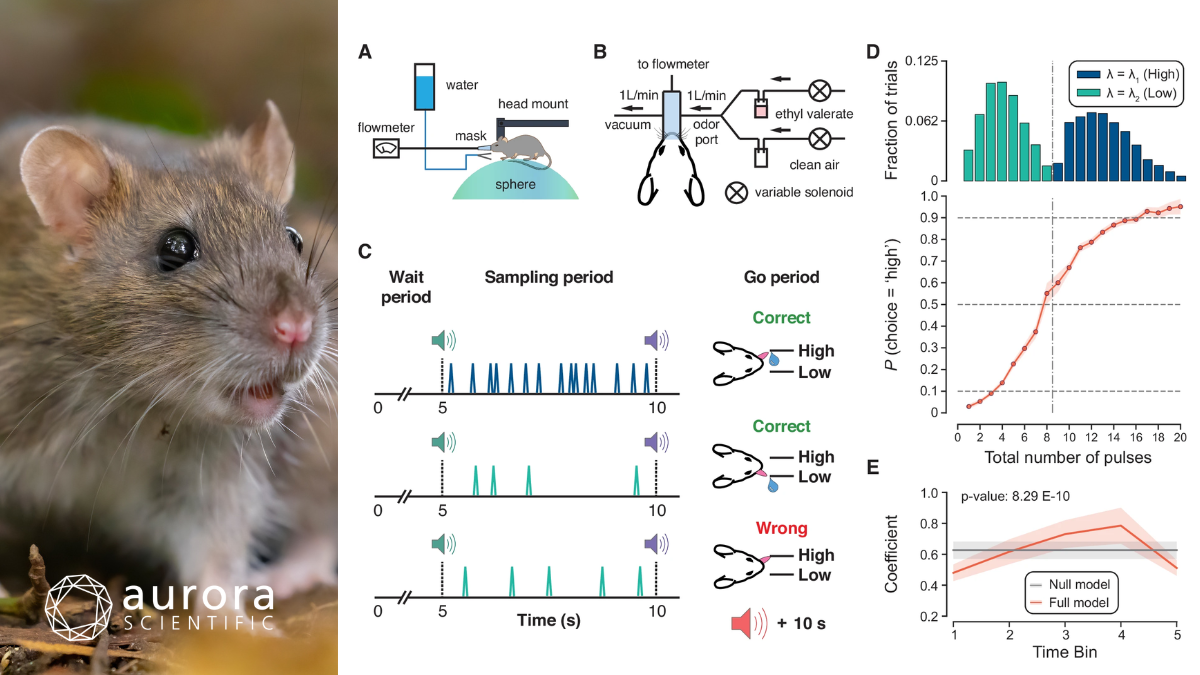
Featured image contains figures adapted from Boero et al. (2026), licensed under CC BY 4.0 depicting A) Head-restrained mice placed over a sphere and a mask fitted to their snout for odor delivery. B) Output of the olfactometer arrives directly to the mask, which is also connected to a vacuum line, and a flow sensor for breathing monitoring. C) Schematic of the behavioural task and three example trials with their corresponding outcomes given the number of pulses delivered. D) Top: Distribution of 19,896 trials collected from 7 previously trained mice using a 5 s sampling window; gray dashed line indicates the decision boundary. Bottom: Pooled psychometric curve; orange circles indicate the mean behavioural response and the shaded area represents the 95% CI. E) Mixed-effects logistic regression coefficients comparing the ‘Null’ and ‘Full’ models using odor information divided in 5 bins. Models were compared using a log-likelihood ratio one-sided test with the p-value of the comparison indicated. Data is expressed as mean ± CI 95%.
Perception and Neural Representation of Intermittent Odor Stimuli in Mice
In nature, odor cues present themselves sporadically for a variety of reasons, such as turbulent and unpredictable air flows, and intermittent and changing odor sources. Mice and other animals must navigate these unpredictable odors to find mates, locate food and avoid predators. For mice and many larger animals, Boero et al. (2026) surmise that the olfactory landscape is characterized by periods of ‘whiffs’ and ‘blanks’. How are mice able to integrate these changing and intermittent cues? The features of olfactory stimuli that mice rely upon to ascertain information about the odor source also remain unclear.
The authors of the study used a custom fast-switching olfactometer similar to our 220A: Olfactometer and validated its release profile using a 200B: miniPID Fast Response Olfaction Sensor to design periods of very short pulsed periods of ethyl valerate release. A head-fixed mouse had a choice of high or low pulses and received a water reward if correct. Because the pulses lasted only 50mS (confirmed by our miniPID), there would naturally be several which would coincide with exhalation rather than inhalation during the breathing cycle of the mouse. Pulse onsets were completely randomized, so this variability naturally would affect decision-making ability.
Data analysis of the mouse trials and cortical imaging data showed that the mice placed much higher emphasis and were biased towards pulses which arrived during inhalation as opposed to during exhalation. Importantly, when pulses arrived in close sequence during inhalation, they could be effectively ‘summed’ to be perceived as a signal of higher amplitude. This was confirmed by measurements from of our miniPID. The neurons in the anterior cortex of the mice respond more strongly to these periods of ‘summed’ odor ‘whiffs’ or pulses; however, the cortex itself is not storing this evidence of odor cues over time. This means that the mouse is limited by and extremely reliant on its sniffing cycle to use these odor ‘snapshots’ to guide its decision-making.
Evidence that Dogs Can Use Temporal Difference in Odorant Arrival to Discriminate Odorant Mixtures
In nature and our natural environment, odors from a discrete source travel or are carried in a plume. However, our natural environment is not made up of a few clean plumes which are easily identified. In reality, our airflows are turbulent, and there are countless background odors which mask subtle odor plumes from a desired source. How then can mammals track and discriminate these odors? In this study, Downie et al. (2026) surmised that dogs are able to use the fact that discrete parts of an odor mixture arrive at different times in order to track a desired odor plume. This approach was novel as it did not tie the temporal differences in binary odor mixtures to the natural sniffing cycle of the dogs, and simply looked at temporal separation of the mixture parts.
Odorants were presented as continuous pulse trains that were not tied to any specific behaviours of the dogs, and persisted until the dogs would interact with them. This allowed the dogs to sniff freely, more closely resembling how they would in nature. Pulsed binary mixtures of n-butyl acetate and ethyl buterate were generated by a custom olfactometer and odor presentation onset times, as well as rise and decay times, were validated with an Aurora Scientific 200B: miniPID Fast Response Olfaction Sensor. Various training trials were performed to acclimate the dogs to the experimental setup and to determine that they could, in fact, discriminate between the parts of a binary mixture. Various randomized trials with varying offset times between the mixture of two odors were performed.
Although some of the dogs were removed from the study for insufficient interactions with the tasks, and there was some potential for auditory biasing from the device, the study showed that domestic dogs can indeed determine between a two-part odor mixture which only differed in the onset times in asynchrony of the mixture parts. Evidence showed that this asynchrony threshold was between 600-700mS. These early findings suggest that dogs resemble other vertebrates that have a similar ability to use subtle temporal odor cues for tasks such as source location and odor discrimination, though these asynchrony times are much larger than those of smaller animals such as mice. Further investigation using an approach independent from an animal’s natural breathing or sniffing cycle would be beneficial.
Conclusions
These studies by Boero et al. (2026) and Downie et al. (2026) contribute to our understanding of how animals interact with odors in the natural environment to perform basic biological functions required for survival, and mate selection. While our instruments play a small role in these studies, they are representative of the small but meaningful step that each study and each piece of data plays along the path towards a large breakthrough or discovery. We are proud to support this amazing research.
If you have any suggestions for future publication reviews, please reach out to us directly with your suggestions and we would be glad to feature your own research or that of a colleague’s!