Annually, during the month of July, many cardiologists and physiologists will typically attend the American Heart Association’s Basic Cardiovascular Sessions (BCVS), taking place in Boston this year. At this meeting, researchers will present and discuss the latest breakthroughs, and experimental techniques in cardiac function, circulation, and various other topics which pertain to the cardiovascular system. This publication review pays homage to the recent advances and discoveries related to cardiovascular research highlighting the latest therapies and interventions to fight cardiovascular and metabolic diseases. From human pluripotent stem cels, to creatine supplementation these papers represent an important peek at some of the research going on at this very moment to help fight cardiovascular disease and its effects.
Featured image contains figures adapted from Basu et al. (2026), licensed under CC BY 4.0) depicting A) H&E-stained muscle sections 42 days post-injury with dashed yellow lines indicating the defect region and white boxes showing magnified areas. B) VML-injured TA muscle mass measured 42 days post-injury (n = 5–6/group). C) Eccentric torque increased with 150 Hz stimulation and across bouts. D) Change in eccentric torque between bouts 1 and 8 with no differences between 100 Hz and 150 Hz programs with hydrogel treatment; dotted lines indicate values from untreated VML-injured muscles reported by Ziemkiewicz et al. (2023). E) Peak isometric torque measured and normalized to body weight. Statistical analyses were performed using two-way ANOVA or unpaired t-tests, with significance indicated by * p < 0.05, *** p < 0.001, and **** p < 0.0001.
Human induced pluripotent stem cell-derived mesenchymal stromal cells regenerate diabetic ischemic muscle
For diabetic patients who are in the late stages of Peripheral Artery Disease, Chronic limb threatening ischemia (CLTI) often carries a 5-year mortality rate of roughly 50% and is associated with an annual amputation risk of 25%. The estimated affected population in the United States alone is approximately 500,000 persons and standard cellular therapies frequently fail to prevent amputations or improve revascularization. Rejuvenated HiPSC-MSCs bypass these limitations by offering a scalable, highly potent alternative promoting revasculation and muscle regeneration. Basu et al. (2026) put these assumptions about HiPSC-MSC’s to the test in a diabetic mouse model of CLTI to test whether critical functional markers of muscle and vascularization could be improved.
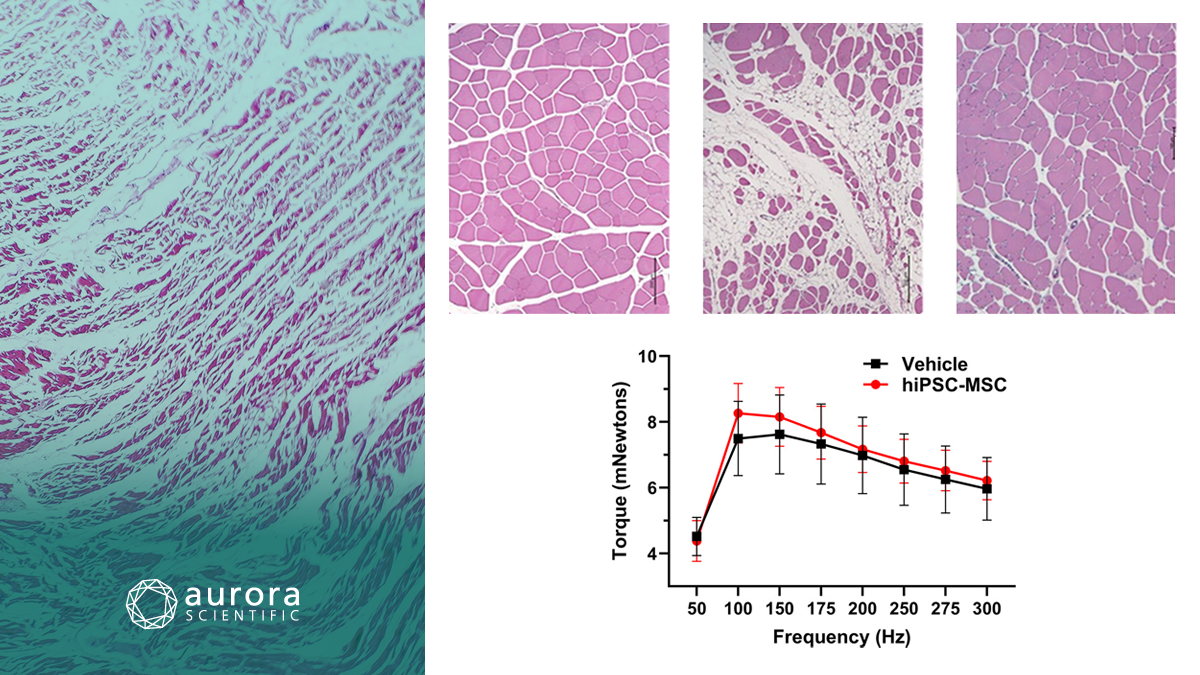
The study took a diabetic mouse model and applied femoral artery ligation to induce a model of CLTI. HiPSC-MSC’s were injected seven days following the ligation surgery. Reperfusion was assessed by laser doppler perfusion imaging and muscle function was assessed with Aurora Scientific’s 1300A: 3 in 1 Whole Animal System for Mice. Plantar flexion torque was assessed at pre-surgical baseline and then weekly followed femoral artergy ligation. Peak torque and force frequency protocols were employed.
Treatment with HiPSC-MSC injection showed increased in peak torque and a marked improvement in perfusion ratio. Other markers such as histology showed a vast improvement and there was a large stimulation in angiogenesis in these stained sections of gastrocnemius muscle. Altogether, HiPSC-MSC treatment showed attenuation of ischemic muscle damage, and promoted an improvement in muscle function, perfusion, and angiogenesis. This study demonstrates that HiPSC-MSC have the potential to be a impactful and accessible therapy for late stage peripheral artery disease and further investigation would be prudent.
Creatine supplementation and respiratory muscle function in health and disease: translational insights from human to mouse
Respiratory muscle weakness is a hallmark of cardiovascular diseases such as Heart Failure (HF), Chronic Obstructive Pulmonary Disease (COPD) and also occurs commonly in ageing populations. Respiratory muscle weakness is also associated with increased exercise intolerance for those affected, which shunts one of the best and most accessible tools available for these patients. In this study, Price et al. (2026) investigated the use of Creatine supplementation to improve respiratory muscle function in both humans and mice. Creatine supplementation has been widely studied as a means of increasing skeletal muscle mass but studies on its effectiveness on respiratory muscle function a very sparse; making this a truly novel idea.
Humans and mice took daily creatine supplementation orally for a period of 3 to 4 weeks respectively. In humans maximum inspiratory pressure baseline was measured and a protocol of inspiratory breath training was undertaken twice daily for 4 weeks with an inspiratory training device. In models of healthy mice and (HF) mice, the study also used an Aurora Scientific 1200A: Isolated Muscle System for Mice to assess contractile function of fiber bundles from the costal diaphragm. Standard protocols of twitch and tetanic kinetics were used, as well as Force-Frequency and Fatigue.
Treatment with Creatine Supplementation showed attenuation of diaphragm muscle weakening in the HF model of mice, though there was no statistically significant change in the healthy, wild type animals. In the human models, increases in maximal inspiratory breathing pressure were observed for those subjects who were supplemented with Creatine. These early findings suggest that creatine supplementation has the potential to improve diaphragm and respiratory muscle function in preclinical models of heart failure, and merit further studies and investigation.
Conclusions
These studies by Basu et al. (2026), and Price et al. (2026) contribute to the cardiovascular research communities’ understanding of potential emerging therapies to help preserve muscle function in various models of cardiovascular and metabolic diseases. They are representative of the small but meaningful breakthroughs that our research instruments help to facilitate in tandem with other established experimental protocols and techniques.