April brings the American Physiology Summit to Minneapolis, where researchers from across the globe will gather to exchange new insights into the mechanisms that govern physiological function. Alongside the summit, Aurora Scientific’s joint presence with ALZET® Osmotic Pumps, representing Lafayette Life Science, highlights a continued commitment to enabling precise experimental approaches for studying physiology under stress and adaptation. This year, there’s particular attention on how mechanical and pathological challenges reshape musculoskeletal and organ function, as three recent studies reveal unexpected links between disease state, experimental protocol, and force generation. The following publication review enforces how kidney disease, smooth muscle preconditioning, and combined sepsis and disuse each recalibrate the way tissues generate, transmit, and recover force.
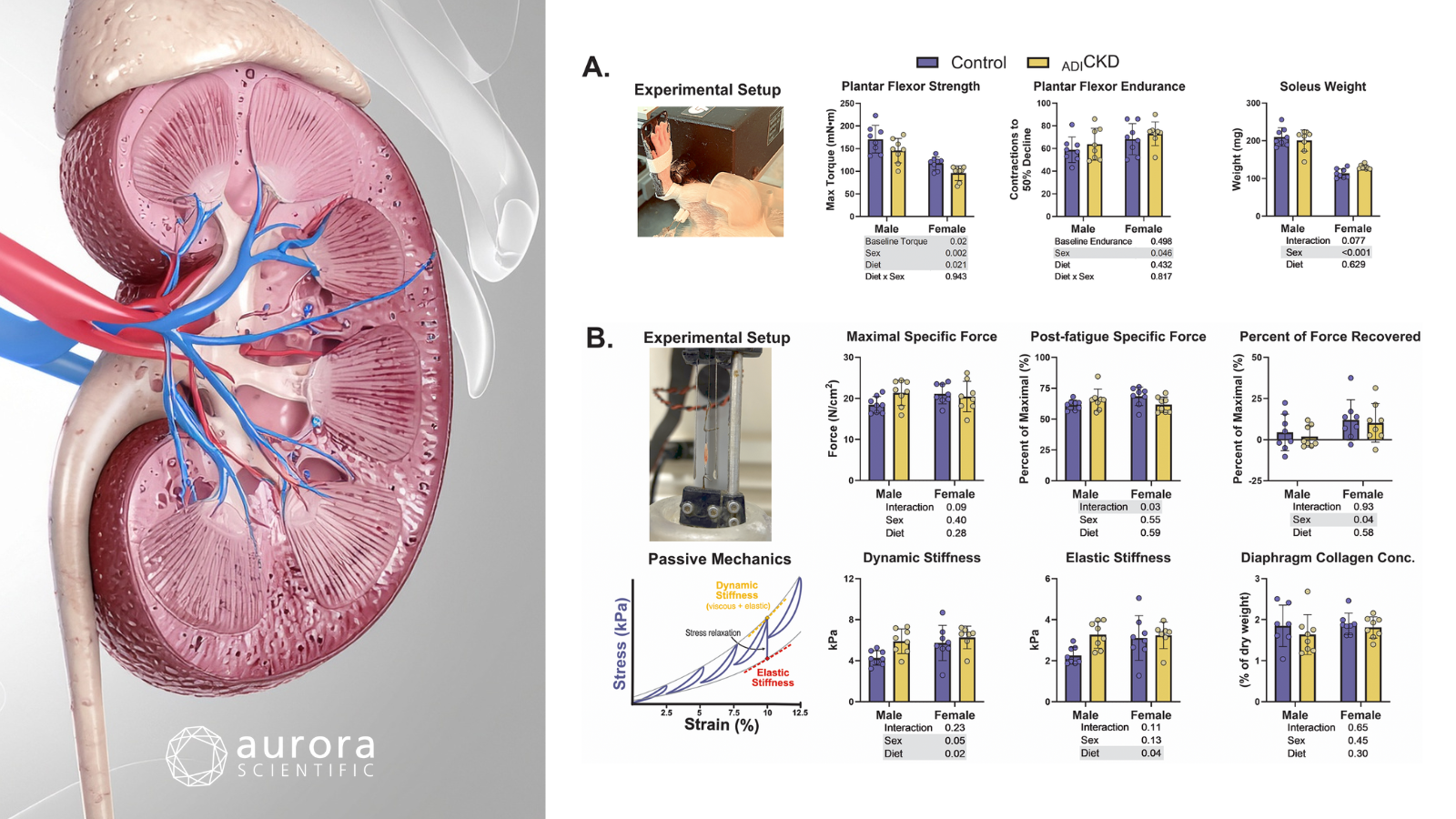
Featured image (human kidney cross section photo by TrueCreatives via Canva.com with figures adapted from ©Hayden et al. (2026), licensed under CC BY 4.0) depicts the effects of a 0.25% adenine diet on Sprague–Dawley to induce kidney disease (ADICKD). A) In-vivo assessment of plantarflexor strength and endurance, as well as soleus mass. B) Ex-vivo analysis of diaphragm muscle stiffness and collagen content.
Kidney Disease Impairs Tendon Function in Rats
Chronic kidney disease (CKD) is well known for its association with muscle wasting and bone fragility, yet its effects on tendons remain comparatively understudied. This is particularly notable given clinical reports of spontaneous tendon ruptures in CKD patients during routine activity, despite a lack of mechanistic evidence. To address this gap, Hayden et al. (2026) used an adenine-induced rat model of CKD to assess coordinated changes in tendon, muscle, and bone function.
To induce kidney disease, male and female Sprague–Dawley rats were fed a 0.25% adenine diet (ADICKD) and compared with controls. Both cohorts were then evaluated through in-vivo performance testing followed by tissue collection for mechanical, biochemical, and histological analyses. Muscle function was assessed using Aurora Scientific’s 300C-LR: Dual-Mode Muscle Lever, 800A: in-vitro Muscle Apparatus, and 701C: Electrical Stimulator enabling precise measurements of plantarflexor torque (in-vivo) and diaphragm contractility (ex-vivo) under controlled stimulation. Tendon and bone tensile properties, collagen content, and molecular markers of muscle tissue were also quantified.
Nine weeks of adenine feeding induced marked renal dysfunction alongside reductions in bone quality and strength, particularly in males. Functionally, plantarflexor strength was reduced despite preserved endurance, while the diaphragm exhibited increased passive stiffness without changes in active force. In-vivo torque production declined, although ex-vivo contractile capacity remained largely intact with altered passive mechanics. Tendons showed reduced failure stress—most notably in the tibialis anterior—without changes in size or collagen content. Together, these findings provide the first direct evidence that CKD compromises tendon integrity while producing distinct, tissue-specific effects across muscle and bone, highlighting its broader multisystem impact.
Shaping Smooth Muscle Forces: The Role of Preconditioning in Urinary Smooth Muscle
Smooth muscle exhibits rapid, stimulus-dependent mechanical adaptation, making reproducible measurement challenging. Preconditioning is commonly used to stabilize tissue responses, yet its influence on force production and variability remains poorly defined, particularly when comparing conventional and emerging approaches such as free contraction. To address this, Kiem et al. (2026) examined how different preconditioning strategies shape smooth muscle mechanics in porcine urinary bladder tissue.
Muscle strips were standardized and assigned to passive cycling, no preconditioning, or free contraction protocols before undergoing identical stretch and isometric testing. Mechanical measurements were performed using Aurora Scientific’s 1200A: Isolated Muscle Test System, allowing precise control of length and force during electrical stimulation. Active and passive tensions were quantified and compared across groups, with variability assessed using coefficient of variation and bootstrap analysis.
Smooth muscle behavior was strongly protocol-dependent. Passive cycling produced the greatest stretch and highest active and passive tensions, while free contraction preserved lengths closest to baseline. Across all conditions, active tension increased and passive tension decreased between the first and second contractions, highlighting pronounced history dependence. Although passive cycling maximized force output, it also introduced the greatest variability, whereas no preconditioning and free contraction reduced variability in active and passive measures, respectively. Collectively, these results demonstrate that preconditioning strategy critically shapes both the magnitude and reproducibility of smooth muscle mechanics.
Interaction of Sepsis, Disuse, and Aging in Skeletal Muscle Function and Remodeling in Male and Female Mice
Sepsis is a major driver of skeletal muscle weakness and atrophy, particularly in older and critically ill populations, yet it rarely occurs in isolation from prolonged disuse. Despite this, most preclinical studies examine these factors independently, and the influence of age and sex on outcomes remains incompletely defined. To address this, Muller et al. (2026) investigated the combined effects of sepsis, disuse, aging, and sex on muscle function and recovery.
Mice underwent cecal ligation and puncture to induce sepsis, followed by hindlimb suspension or normal ambulation, with a subset undergoing reloading. Ex-vivo contractile function was assessed in isolated soleus muscles alongside histological analyses of fiber size, inflammation, extracellular matrix remodeling, and satellite cell content. Force production and tissue-bath-based assessments of contractile properties were measured using Aurora Scientific’s 1200B: Integrated Isolated Muscle Test System with 612A: Dynamic Muscle Analysis, High-Throughput Software.
Outcomes varied markedly with age, with young mice remaining resilient while older animals showed reduced survival and greater body mass loss, especially under combined sepsis and disuse. Disuse emerged as the primary driver of weakness and atrophy, producing substantial reductions in force and fiber size, while sepsis contributed smaller but additive inflammatory and remodeling effects. Ex-vivo testing revealed persistent impairments in force-frequency responses, with incomplete recovery after reloading, particularly in older septic males. Overall, the findings indicate that disuse dominates functional decline in sepsis, while age and sex shape severity and recovery trajectories.
Conclusions
Force and foremost, these studies by Hayden et al. (2026), Kiem et al. (2026), and Muller et al. (2026) demonstrate how mechanical function across tendon, smooth muscle, and skeletal muscle is reshaped by disease state, experimental design, and physiological context. Collectively, they emphasize the importance of precise, systems-level approaches for understanding force generation and adaptation across tissues.