



Calling in Reinforcements: Tube Repair of an ASI 400 Series Force Transducer
During this Tech Cast, Katherine Athaide reviews how to perform a tube repair on our isometric 400 Series Force Transducers used to measure contractile force from a variety of muscle tissues including, skeletal, smooth, and cardiac muscle as well as connective and engineered tissues. These transducers make a great addition to a variety of experiments in muscle physiology and material science research, with their capability of measuring force in, done in both tension and compression, with a high resolution and low compliance.
For each section of the tech cast, Katherine and our Test Technician Terry, walks viewers through a step-by-step video guide of how to conduct a tube repair.
This video outlines the following:
- Removing the sensor head cover
- Removing old epoxy and output tube
- Attaching the alignment jig
- Mixing and applying epoxy glue
- Removing the alignment jig & reattaching the transducer cover
For the breakdown of each step, refer to the sections below…
Required Tools Include:
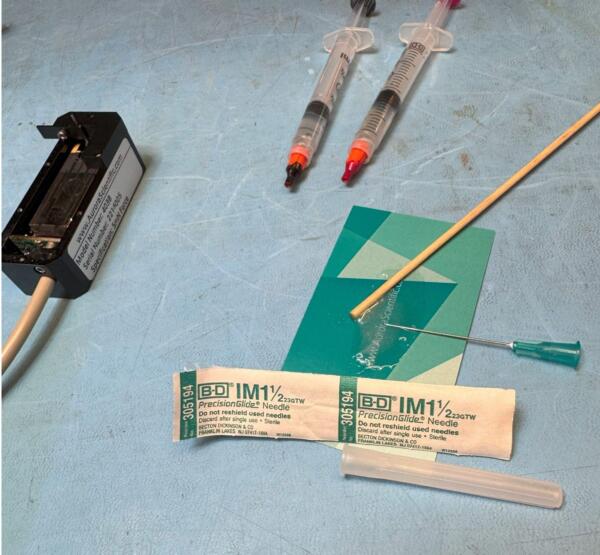
1. Removing the Sensor Head Cover
In this section, we review the steps required to remove the force transducer sensor head cover. Once we carefully remove the cover plate, the transducer flexure is visible with the broken output tube. Please note the flexure should still be intact.
2. Removing Existing Epoxy and Output Tube
Next we walk you through best practices for removing the old epoxy and the output tube left on the flexure. Using the butane-powered hot air torch and X-Acto knife in the tube repair kit, we explain how to remove the epoxy. As an added bonus, Terry shows us how to clean off any remaining residue left on the glass flexure.
3. Attaching the Alignment Jig Cover
Next, we attach the tube alignment jig to locate where the new output tube will be glued.
4. Mixing and Applying Epoxy
In this video, we thoroughly mix epoxy resin and hardener using a mixing tool, in order to glue a new tube to the flexure. . Note you should mix for at least 1 minute. The epoxy cures in 5 minutes so ensure that you are ready to glue before mixing the glue. Take care not to get any epoxy on your skin.
5. Removing the Alignment Jig and Reattaching the Cover
The final step involves removing the alignment jig and reattaching the force transducer cover. If the cover fits back on without the tube touching the hole in the cover plate, congratulations—you’ve successfully completed the tube repair!
For the text version of this protocol, please refer to our written blog Performing a Tube Repair of an ASI 400A Force Transducer.
You can also find the 400C Force Transducer Manual on our Support page.
If you have any remaining questions, please contact us at +1(905)-727-5161 or email us at info@aurorascientific.com.