



Straight from the Vault: Introducing Aurora Scientific and AMB’s Inaugural Collaboration, the 840A BioVault



In February this year, Accelerated Muscle Biotechnologies and Aurora Scientific formed a strategic partnership, combining expertise in muscle physiology research and reliable instrumentation and manufacturing to support it.
Hear from Anthony, Khoi, and Aurora Scientific to learn more about AMB, this new found partnership and their goals for the future below!
About Accelerate Muscle Biotechnologies (AMB)
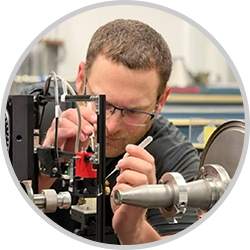
Anthony Hessel, PhD
Co-Founder & CEOAnthony has been a muscle physiologist for over 15 years, specializing in the inner workings of heart and skeletal muscle sarcomere interactions and muscle performance. Currently residing in Germany, he works with small angle x-ray diffraction using particle accelerators called synchrotrons. His overall goal is to make this technique more accessible to researchers.
Khoi Nguyen, PhD
Co-Founder & CTOKhoi has a background in mechanical engineering and delved into muscle mechanics during his post-doc, where he focused on MRI imaging. As the primary image and signal processing expert, he looks forward to making this x-ray diffraction technique available to more labs, so that they can obtain these exploratory data sets for their work.

How did AMB come to be?
The AMB partnership begins with a fortuitous twist of fate—and a well-timed tweet. When Anthony’s research at Argonne National Laboratory was put on hold due to a major beam line upgrade, he found himself searching for an alternative synchrotron to continue his work. While living in Germany, he discovered a facility in Hamburg that had all the capabilities to make his beam line dreams come true. It was there that colleagues encouraged him to think bigger: What if he could help other researchers collect their own data using the x-ray diffraction setup he had established?
That’s when fate intervened in the most modern way. Anthony posted on Twitter inquiring about assistance for software development, and at that exact moment, Khoi was exploring research-based opportunities for his next career move. When their respective PIs—who happened to be friends—connected them over the tweet, the match was instant. In what can only be described as scientific serendipity, their complementary skills and aligned vision came together.
What is MyoSAXS and its purpose?
MyoSAXS stands for muscle small-angle x-ray diffraction scattering—a cutting-edge technique that reveals the hidden architecture of muscle at the molecular level. The process requires a particle accelerator that generates x-rays, which are then aimed at muscle tissues. The resulting diffraction pattern acts like a molecular fingerprint, telling us about the proteins within the muscle and providing detailed insights into the “motor” or fundamental building blocks that make muscle contraction possible.
Anthony explained to us: “You can think of it like your car. When the engine has a problem, you bring it to the mechanic, you open up the hood, and you look at the engine, maybe try to turn on the car and move the steering wheel. So, you’ve diagnosed a problem this way. This is what we do, but with muscles and particle accelerators.”
SAXS offers a perspective into the molecular inner workings of living muscle, with applications spanning the research landscape. By revealing the molecular structure underlying critical scientific questions. The result is invaluable: unique information at the sarcomere level that shows exactly what’s happening inside the muscle—data that provides evidence needed to advance everything from drug development to disease understanding.
What is the goal of AMB?
AMB’s mission is ambitious yet clear: to transform a niche technology used by only a handful of labs into a widely accessible tool with long-term impact. By democratizing access to MyoSAXS, AMB aims to empower researchers across the globe to answer questions that were previously out of reach—accelerating discoveries that could reshape our understanding of muscle function, disease, and treatment.
As Anthony puts it, “X-ray diffraction is just another tool in the tool belt of muscle scientists to look at what’s happening, to define whatever they are trying to characterize in tissue.”
Khoi said it perfectly, “AMB’s team members are scientists first.”
Unlike traditional contract research organizations, AMB maintains its roots in academia. Team members continue conducting their own research alongside client work, ensuring they stay at the cutting edge of the field. More importantly, AMB doesn’t just work for clients—they work with collaborators as equal partners. This is a reflection of their genuine passion for scientific discovery.
How did the partnership between AMB and Aurora Scientific come about?
The alignment runs deep. Aurora Scientific shares AMB’s belief in advancing research through strong communication—highlighting quality science from labs around the world. What resonated with Aurora was AMB’s dedication to generating reproducible scientific outcomes through standardized methodologies. Aurora Scientific recognizes that consistent, reliable results come from these standardized methods. For AMB, the collaboration means access to high-quality instrumentation essential to making meaningful contributions to the scientific field. It’s a partnership built on engagement, shared vision, and a commitment to elevating muscle research globally.
AMB is setting out to create the next generation of muscle mechanics tools, and Aurora Scientific is the ideal partner to make it happen. Aurora’s deep engagement with their customer base gives them unique insight into the challenges researchers face in real-world experiments—knowledge that will directly inform the solutions AMB and Aurora develop together.
The ultimate goal? Increasing accessibility to as many labs as possible through commercially available options that don’t compromise on quality.
Introducing the BioVault
Innovation in muscle research often comes from lived experience at the bench, and sometimes from challenges encountered thousands of miles from home. The BioVault is the latest example of that spirit: a contained muscle holder designed to increase efficiency, improve compliance, and unlock higher-throughput experimentation at synchrotron facilities worldwide.
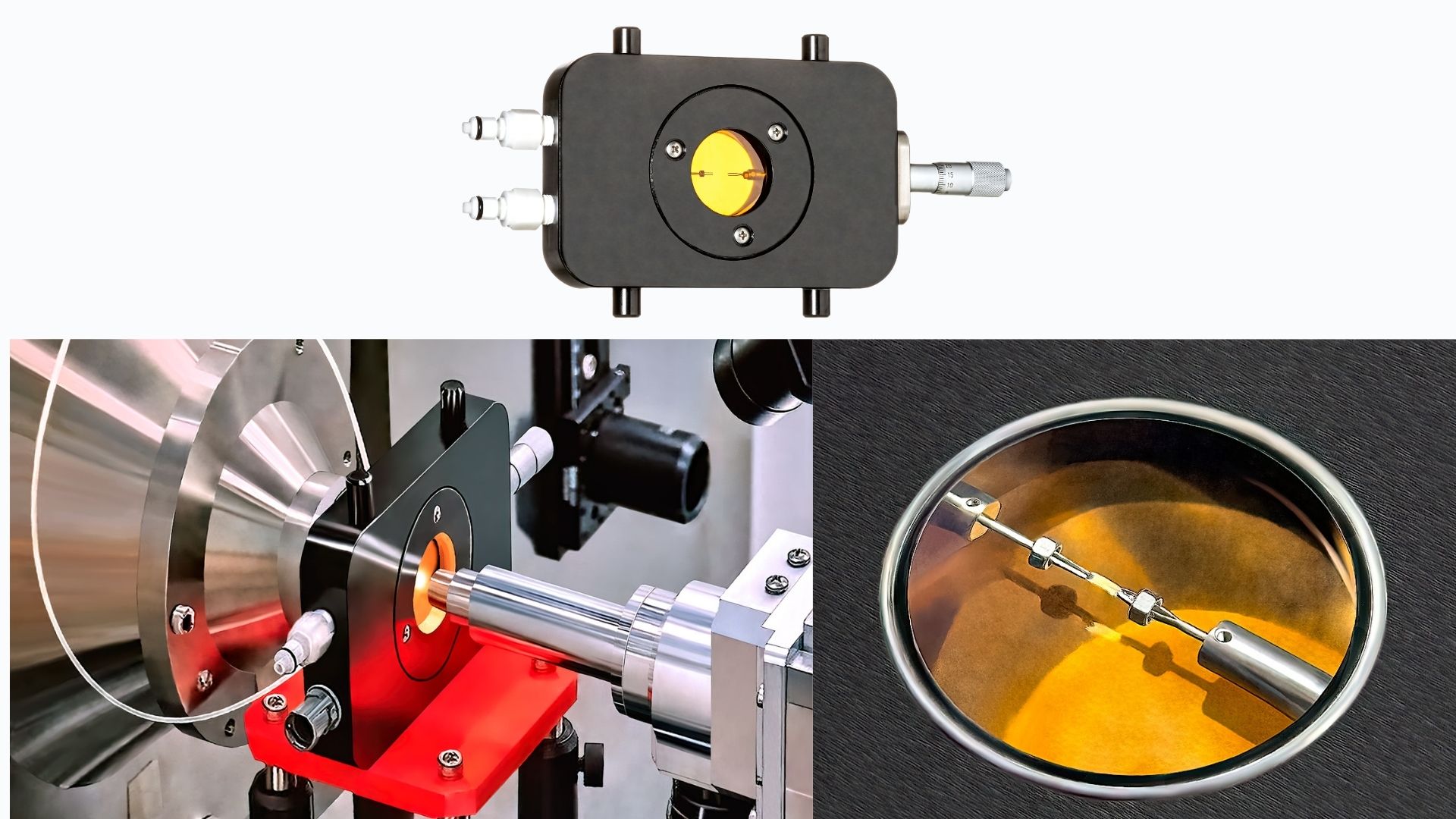
What is the BioVault?
The BioVault is a containment unit—known as a cassette—that securely houses muscle samples, whether pre-prepared in a lab or prepared on-site. Designed for both intact and permeabilized tissues, it allows researchers to:
- Prepare multiple samples in advance
- Transport tissues in a contained, compliant format
- Plug directly into a beamline-compatible Aurora system
- Begin data acquisition immediately
The goal is clear: increase throughput and efficiency. Instead of spending valuable beamline time loading and mounting tissues, researchers can prep samples ahead of time and use their synchrotron access purely for data collection.
The Origin Story: Creativity in Transit
The BioVault was born out of necessity.
While conducting experiments abroad, Anthony encountered unexpected lab compliance requirements when testing permeabilized human tissues. The host lab required tissues to remain within a contained environment for processing and testing—a regulation he hadn’t anticipated.
Without the proper containment system, running experiments became nearly impossible.
On the journey home, inspiration struck as Anthony envisioned a piece of equipment that could securely house muscle tissue, incorporate micromanipulators to change sample length, optical windows to enable laser diffraction, and maintain compatibility with synchrotron beamlines.
When Aurora Scientific joined the discussion, the concept evolved from a solution for one lab into a scalable tool for the global muscle research community.
As Khoi pointed out, “The true limitation wasn’t the beamline—it was sample preparation. The estimated time of sample prep time being ~25 minutes vs. Data acquisition at ~5 minutes.”
In other words, researchers were spending five times longer preparing tissue than actually collecting data.
With the BioVault tissues can be prepared outside the beamline environment, so scientists can maximize every minute of synchrotron access. Preparation and experimentation now run in parallel instead of sequentially—dramatically improving throughput and cost efficiency.
How could this technology be used in the muscle research community? Where else could it add value?
The BioVault isn’t just a transport container—it’s a dynamic experimental platform.
It offers:
- Fluid exchange capabilities for solution swaps
- Storage flexibility, including temperature control and flash freezing
- Compatibility across a broad array of muscle mechanics experiments
- Adaptability for both skeletal and cardiac muscle studies
Beyond beamline use, its contained design also enables researchers to mount samples in designated biosafety-level environments, then transfer them with minimal contamination risk into experimental spaces.
The BioVault’s impact extends far beyond a single workflow improvement.
By simplifying methodologies, minimizing downtime, and enabling higher throughput, it supports:
- More efficient use of beamline time
- Reduced material waste
- Standardized preparation techniques
- Improved reproducibility
While developed with muscle mechanics and X-ray diffraction in mind, its design principles may benefit adjacent fields as well—including emerging applications in plant and material science.
Where do you anticipate this partnership going or what could it enable in the future?
What makes this collaboration unique is the shared mindset behind it.
Anthony reflects: “We are organically coming up with the next projects. AMB and Aurora share a level of trust and a commonality of tinkering and trying things out, that naturally different projects are being brainstormed.”
Through their combined networks, new opportunities continue to emerge—gaps in methodology, inefficiencies in workflow, and areas where standardization could elevate entire fields.
From Aurora’s perspective, having scientist-founders like Anthony and Khoi offers a different lens on what the muscle research community truly needs—and what it doesn’t even realize it needs yet.
Together, AMB and Aurora are not just building tools. They’re shaping infrastructure for the future of muscle science—and potentially beyond.
And the BioVault is only the beginning.
Explore Interviews, Webinars, & More!
NASA’s SpaceX CRS-29 launched on November 9th carrying the Rodent Research-20 (RR-20) payload, the contents of which will be studied by Brock University’s Dr. Val Fajardo and his team using Aurora Scientific equipment upon its return.
Interviewing Dr. Arthur Cheng at the Muscle Health Research Centre (MHRC), York University, whose lab primarily investigates the mechanisms of skeletal muscle weakness and fatigue.
System setup guide for the 1200A in-vitro muscle test system.