



220B: Olfactometer
The 220B Olfactometer delivers odors of a desired concentration with precise onsets and latencies for studying behavioral response, central processing of olfactory information in the brain and for sensory physiology.
Optimal fluid design ensures repeatable odor profiles generated with minimum time delay between activation and arrival of the odor at the subject. The system uses three mass flow controllers and a series of precision valves to mix the selected odorant with a dedicated clean air line. The 220B can be configured with 4, 8, 12 or 16 vials for maximum flexibility. Odorants are stored in 40mL vials in a liquid phase and are sampled from the vapor headspace of the vial.
As with our previous models our brand new 220B is designed for continuous airflow and washing to eliminate odorant residues, decreasing the likelihood of cross-contamination. A final valve located close to the release point is used to switch between clean air and the odorant stream, achieving steady state concentration in as little as 25 milliseconds. In addition, the 220B can produce multiple odor applications during a single experiment in a very compact form factor without the need to change vials.
Lab tested design and with the same great proven performance, the 220B Olfactometer is now offered at a lower price point while still reliably produce odors at the desired concentration for the most demanding olfaction experiments.
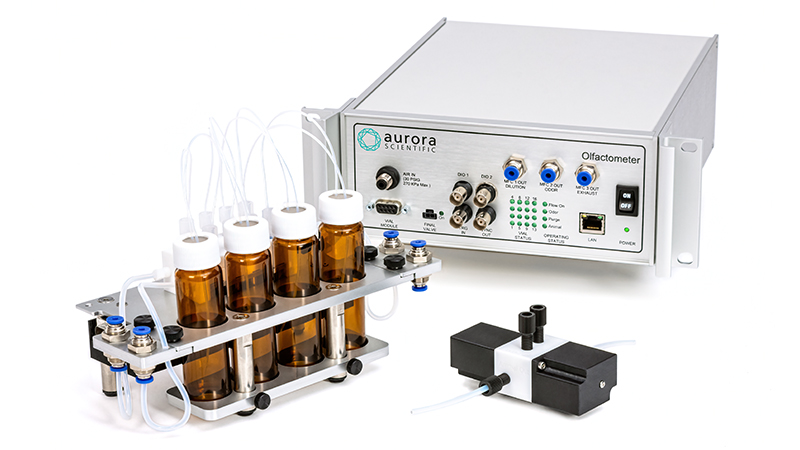
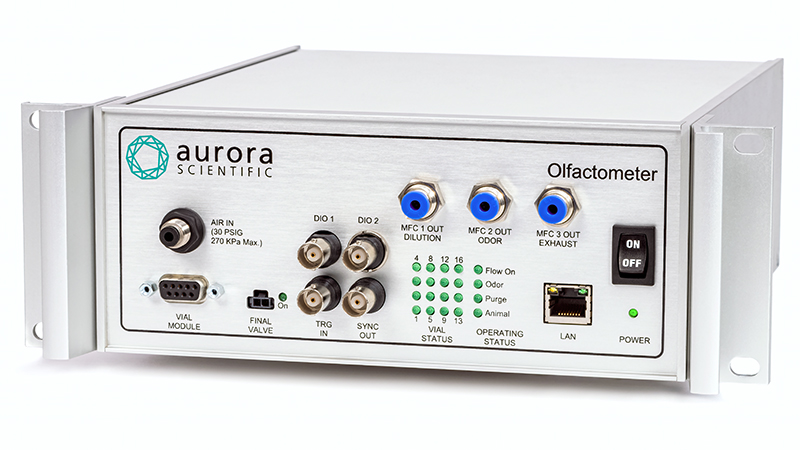
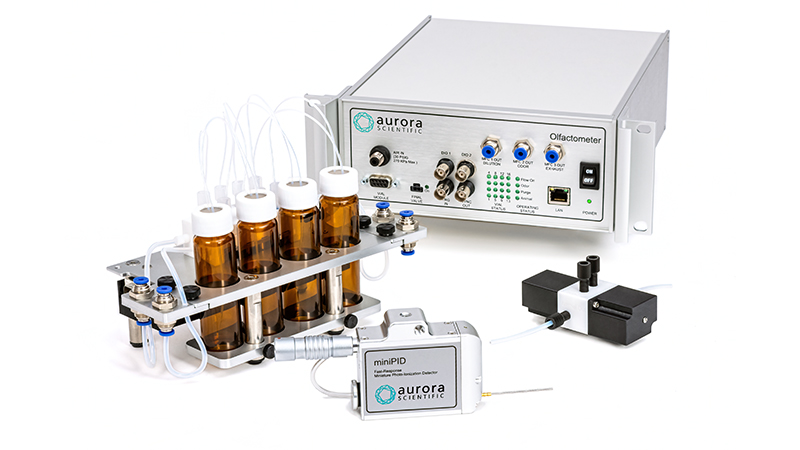
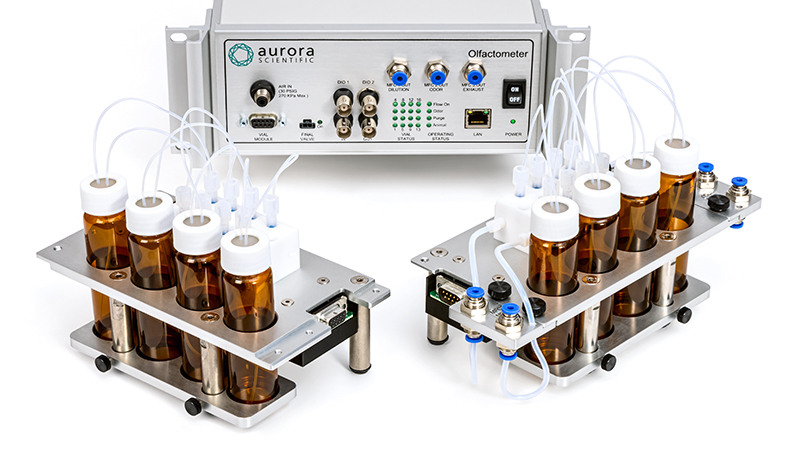
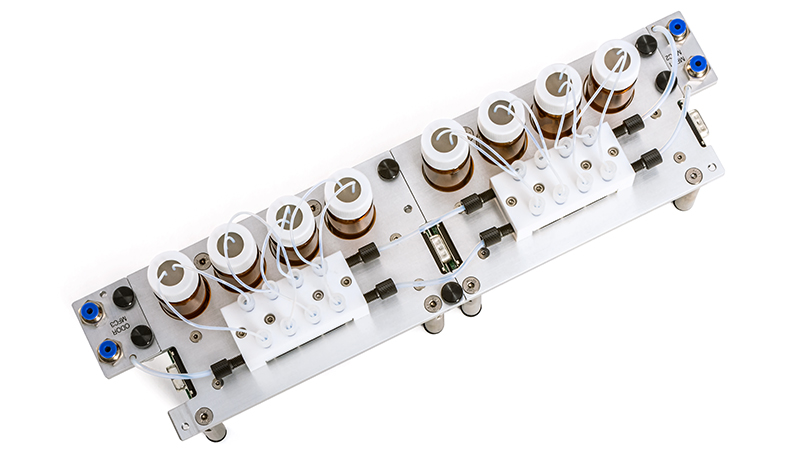
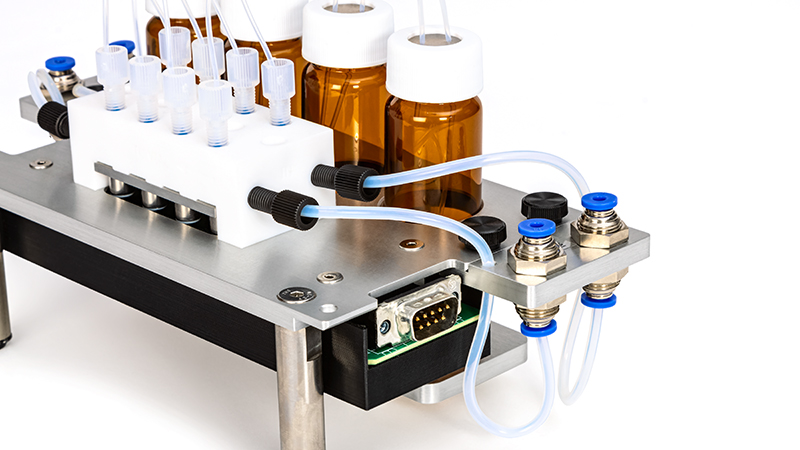
Variant
220B-4VMOD Olfactometer Expansion Module:
4 channel expansion module, expanding your olfactometer to up to 16 odor vials
Stories of Success
220B – Switching Olfactometers
CHALLENGE
In 2015 Dr Dima Rinberg approached us regarding the design of a new type of switching olfactometer with low presentation latencies and the ability to minimize cross contamination. Professor Rinberg was one of the first olfaction researchers studying behaviour to use our 200B miniPID to characterize the output of his own lab build olfactometers and he recognized the dire need for a standard design that could eliminate some of the biasing problems that many laboratories struggled with. During his time at HHMI Janelia Farm, Professor Rinberg developed an early 2 mass flow controller prototype that was used in his laboratory and that of his colleagues. The design had obvious advantages over other models that were available at the time, and eliminated some of the experimental biasing issues, but it required a great deal of work and polishing to become a consistent and reliable product for any and every lab.
SOLUTION
Aurora Scientific saw the potential in the design and that it could be something that advanced olfaction research. However, we knew that to truly be a solution for every lab, the unit needed to be easy to use, easy to maintain, and robust enough to withstand the rigors of the lab day in and day out. With that in mind we set to work with improvements. A third Mass Flow Controller was added to automate the output pressure balancing which had been manually done before, and the vial arrangement was changed to allow refilling without having to fully disassemble the unit. Modularity in terms of adding vials in the future was improved and controls and electronics were fitting neatly into a compact and easy to connect package. Control software was added and has continuously expanded.
RESULTS
After more than a decade of providing olfactometers to the olfaction research community we are now on our 3rd generation of switching type olfactometer with new and improved valves offering great performance for greatly reduced cost. New and improved variants for mixing odors and higher flow rates are launching soon. We are proud to serve the olfaction research community and look forward to helping you meet your most demanding experimental challenges.
Select References
- Rinberg, Dmitry, Alex Koulakov, and Alan Gelperin. “Speed-Accuracy Tradeoff in Olfaction” Neuron (2006) DOI: 10.1016/j.neuron.2006.07.013
- Rinberg, Dmitry, Alex Koulakov, and Alan Gelperin. “Sparse odor coding in awake behaving mice.” The Journal of Neuroscience (2006) DOI: 10.1523/JNEUROSCI.0884-06.2006
- Koulakov, Alexei A., and Dmitry Rinberg. “Sparse incomplete representations: a potential role of olfactory granule cells.” Neuron (2011) DOI: 10.1016/j.neuron.2011.07.031
- Warnecke et al. “Re-exposure to reward re-evaluates related memories” Current Biology (2026) DOI: 10.1016/j.cub.2025.11.058
- Parnas et al. “Precision detection of select human lung cancer biomarkers and cell lines using honeybee olfactory neural circuitry as a novel gas sensor” Biosensors and Bioelectronics (2024) DOI: 10.1016/j.bios.2024.116466
- Shusterman, Roman et al. “Precise olfactory responses tile the sniff cycle.” Nature Neuroscience (2011) DOI: 10.1038/nn.2877
- Conway et al. “Perceptual constancy for an odor is acquired through changes in primary sensory neurons” Science Advances (2024) DOI: 10.1126/sciadv.ado9205
- Smear, Matthew et al. “Perception of sniff phase in mouse olfaction.” Nature (2011) DOI: 10.1038/nature10521
- Koulakov, Alexei, Alan Gelperin, and Dmitry Rinberg. “Olfactory coding with all-or-nothing glomeruli.” Journal of Neurophysiology (2007) DOI: 10.1152/jn.00560.2007
- Dewan, Adam et al. “Non-redundant coding of aversive odours in the main olfactory pathway.” Nature (2013) DOI: 10.1038/nature12114
Related Products

200C: miniPID Fast Response Olfaction Sensor
The 200C miniPID photo-ionization detector combines small size, fast response, and high sensitivity in an easy-to-use, competitively priced package.
Learn MoreResources
Specifications
| 220B-4,-8,-12,-16 | 220B-4VMOD | |
|---|---|---|
| Modules Included | All Models: MFC, Mixing, Final 220B-4: 1x 4-Vial Odor 220B-8: 2x 4-Vial Odor 220B-12: 3x 4-Vial Odor 220B-16: 4x 4-Vial Odor | 4-Vial Odor add-on |
| Mass Flow Controllers [SCCM1] | Odor: 0-100 Dilution: 0-1000 Exhaust: 0-1000 | NA |
| Total Flowrate Range [SCCM2] | 100-1000 | NA |
| Odor Vials | 220B-4: 4 220B-8: 8 220B-12: 12 220B-16: 16 | 4 |
| Odor Dilution Range [%] | 0.1-10 | NA |
| Odor Pulse Delay [ms] | 25 | NA |
| Odor Pulse Duration [ms] | 30 – continuous | NA |
| Communications | Ethernet | NA |
| Final Valve Sync Output | BNC, TTL signal Hi: Final Valve Flows to Animal Lo: Final Valve Flows to Exhaust | NA |
| Final Valve Trigger In | BNC, TTL signal triggers opening of Final Valve Hi: Final Valve Flows to Animal Lo: Final Valve Flows to Exhaust | NA |
| DIO 1 Input | BNC, TTL Sequence Trigger | NA |
| DIO 2 Output | BNC, Configurable by user: Sequence Sync Out or Vial Status | NA |
1 = Standard Cubic Centimeters per Minute; 2 = Standard Cubic Centimeters per Minute
| General Specifications | 220B-4,-8,-12,-16 | 220B-4VMOD |
|---|---|---|
| Operating Temperature [°C] | 0 – 40 | 0 – 40 |
| Power Required | In: 100-240 VAC, 50/60 Hz. @ 1.8A | 48VDC supplied by 220B |
| Power Consumption [W] | 15 | 10 |
| Weight [kg] | 220B-4: 3.2 220B-8: 4.8 220B-12: 6.4 220B-16: 8.0 | 1.6 |
| Dimensions [cm] | MFC: 12L x 20W x 14H, 4-Vial Odor: 18L x 15W x 15H, Complete Instrument: 220B-4: 31L x 20W x 15H, 220B-8: 48L x 20W x 15H, 220B-12: 65L x 20W x 15H, 220B-16: 82L x 20W x 15H | 18L x 15W x 15H |
| Software Specifications | 220B-4,-8,-12,-16 and 220B-4VMOD |
|---|---|
| Main Window | Readouts: Flowrate, Vial Flow %, Odor Delivery Duration Status LEDs: Flow, Odor, Purge and Animal, Vial Selection Controls: Flow Odor To Exhaust, Purge, Deliver Odor to Animal, Stop Flow Status line |
| System Configuration Window | Vial list showing Odorant, Solvent and Concentration Controls: Odor Flow Stabilization Delay, Total System Flow Rate Load and Save Config file |
| Advanced Status and Control Window | Displays graphical representation of the olfactometer’s current state and allows manual control of flowrates and valves |
| Valve Check | System check which cycles each valve sequentially |
| Sequencer Window | Create challenge sequences, controls vial, delay time, delivery time Allows sequence to be randomized. Load and Save sequence files |